"Magnificent."
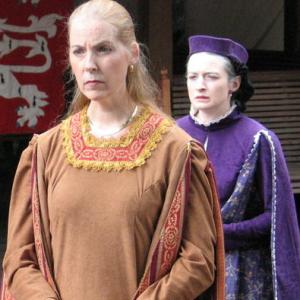
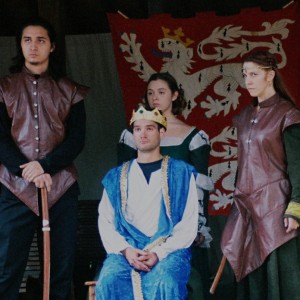
From the opening battle that erupted all around the audience to the final climactic swordfight, the ISC's production of Richard III immersed viewers in a world at war - a world of deception and betrayal, tyranny and rebellion, grief and revenge.
"The energy and intensity were just amazing."
"It was absolutely thrilling."
Richard III dramatizes events that occurred historically between 1471 (the battle of Tewksbury and the crowning of Edward IV) and 1485 (the death of Richard III). It is the culmination of a series of plays dramatizing the struggle between the great families of York and Lancaster for the throne of England, a period of civil war that we now call The Wars of the Roses. Because characters in Richard III often refer back to events covered in earlier plays, the Company designed a short introduction to explain the most important of these previous events and clarify the relationships between the characters.
"Your introduction was brilliant - it made the whole play perfectly clear."
"You really made history come alive."
Shakespeare's history plays are plays first and history second; character and dramatic impact always take priority over historical accuracy. This play has one of the most fascinating characters ever created in Richard III. He can be funny, charming, seductive, pitiful, vicious, or monstrous - and sometimes all of these at the same time. He is a great actor within the play, and his part is of course a great challenge to the actor playing him. And the other characters that surround him are much more than cardboard cutouts - their conflicts with Richard and with each other create a vivid sense of life that fills the entire play.
"The ghost scene sent shivers down my spine -
on a 95-degree August day!"
"The dream sequence was a tour de force."
On the largest scale, though, the primary conflict of this play might be said to be between the characters and the consequences of their own actions. Queen Margaret appears in the play as an embodiment of the spirit of vengeance; the ghosts of Richard's victims return to haunt him, either literally or only in his dreams; and the human resistance that eventually defeats Richard is largely a reaction against his actions and the methods by which he achieves his goals. At the same time, Richard's behavior is at least in part also a consequence of his treatment at the hands of others, during a lifetime of constant war. This is not an excuse for the monstrous crimes he commits, but it is a mark of Shakespeare's genius that he gives us in Richard not a simple comic-book monster, but a complex human being who commits monstrous acts. And this overarching theme - that the consequences of our actions return to haunt us - makes this play not just a great character or historical drama, but a great tragedy as well.
"I've never seen Richard III done so powerfully."
"This is a true gift you've brought to us."
| Richard, Duke of Gloucester, later King Richard III | Danny Makali'i Mittermeyer |
| Richard's Brothers: | |
| King Edward IV | Dave Dietrich |
| George, Duke of Clarence | Robert J DeLuca |
| Lady Anne, later Richard's wife | Betsy Cowdery |
| The Duchess of York, Richard's mother | Megan Shea |
| Supporters of Edward and/or Richard: | |
| The Duke of Buckingham | Sarah K Chalmers* |
| Lord Hastings, the Lord Chamberlain | Amina Omari |
| Lord Stanley | Dave Dietrich |
| Catesby | Sara Clemens |
| Ratcliff | Eric Kincaid Endres |
| The Duke of Norfolk | Jon Rosales |
| The Bishop of Ely | Christina Rockwell |
| Second Murderer | Matthew Lee McKane |
| The Woodville family: | |
| Elizabeth Woodville, Edward IV's Queen | Judith Andrew |
| Prince Edward, her son with King Edward IV | Christina Rockwell |
| Earl Rivers, Elizabeth's brother | Abel McSurely Bradshaw |
| Marquess Dorset, Elizabeth's son by a previous marriage | Emily Shumway |
| Thomas Grey, Elizabeth's son by a previous marriage | Matthew Lee McKane |
| The House of Lancaster: | |
| Queen Margaret | Melanie Uhlir |
| King Henry VI | Eric Kincaid Endres |
| Prince Edward, their son | Jon Rosales |
| The Earl of Richmond | Abel McSurely Bradshaw |
| The Earl of Oxford, his supporter | Robert J DeLuca |
| The Lord Mayor of London | Robert J DeLuca |
| Messengers | Melanie Uhlir Christina Rockwell |
| Bishops | Amina Omari Christina Rockwell |
| Citizens of London | Dave Dietrich, Abel McSurely Bradshaw, Matthew Lee McKane, Jon Rosales, Christina Rockwell |
| Crew | |
| Director | Steve Ponton |
| Stage Manager | Rachel Whelan |
| Production Assistant, Publicity/Poster Design | Melanie Uhlir |
| Costume Designer | Lauren Cowdery |
| Fight Choreographer/Trainer | Christina Rockwell |
| Assistant Fight Trainer | Jon Rosales |
| Drum played by | Matthew Lee McKane |
Melanie Uhlir for all her invaluable assistance; Christopher Bolgiano for his enthusiastic support and all his work on our behalf; all the people at Cornell who worked to make the logistics of this production possible - Biddy Martin, Don Rakow, Kent Goetz, Ann May, Alisa Gardner, Tanya Grove, and many others; Kristin Wolf at Actor's Equity; Chris and Jon of Ring of Steel for all their work on the fights; David Romm for the loan of his timpani.